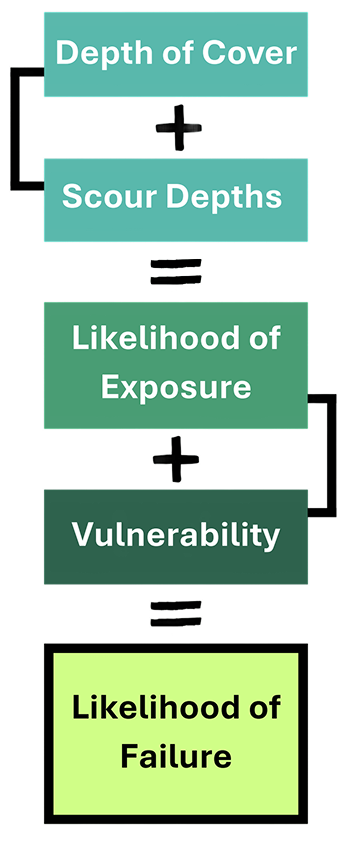
Watercourse hazard has traditionally been assessed through site visits. But it’s only about 4% of sites that represent more than 90% of watercourse hazard exposure. Our probabilistic machine learning techniques quantify uncertainty in predictions and allow screening conservatism to align with organizational risk tolerance. The model integrates a wide range of inputs, including:
- Watershed characteristics (area, hydrology, soils, climate)
- Stream metrics (Strahler order, gradient, flood frequency)
- Pipeline attributes (diameter, wall thickness, material, age, MOP)
Cambio Water Crossing PoF applies supervised machine learningmodels trained on over 33,000 field inspections across ~20,000watercourse crossings across North America.
.svg)


.png)

.svg)

.png)